Monday, May 31, 2010
Brink Of Collapse Coming Faster Than Expected
Euro under new pressure after Spain's debt rating is downgraded ... Markets set to fall after ratings agency Fitch strips Spain of AAA score ... French debt rating also threatened, says budget minister Francois Baroin ... Spain's Jose Luis Rodriguez Zapatero (left) struggled to gain support for austerity measures. His government may also face a general strike. ... The euro is expected to come under further pressure tomorrow as Spain's minority government teeters on the brink of collapse and traders fear contagion throughout the eurozone after a senior French minister admitted that his country's top-notch credit rating was under threat. Stock and debt markets are likely to take a battering after the decision on Friday by the ratings agency Fitch to strip Spain of its coveted AAA credit score, the second downgrade in a month. Fitch's decision was announced after the markets in closed, so traders will have their first chance tomorrow to react, although London and New York will be sidelined by bank holidays. – UK Guardian
Dominant Social Theme: Things are tough and demand austerity.
Free-Market Analysis: What a mess. As can be seen by the article excerpt above, the European Union threatens to come apart at the seams. The debt "contagion" is obviously not stopping, nor can it, given the monstrous overhang that is now being presented to world markets. Spain has been downgraded and other countries teeter on the precipice. We predicted recently that France was in bad shape, and events seem to be moving even faster than we expected – with French officials admitting that French credit ratings could also soon drop.
More Here..
The Looming Financial Holocaust - Is Closer Than We Thought ...
More Here..
| What Do You Think? |
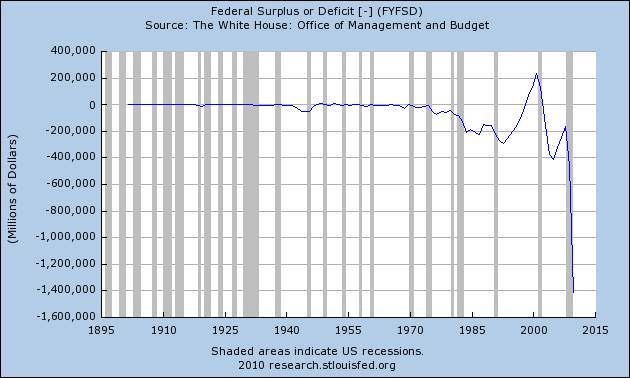
Worst Deficit in 100 Years
(snippet)
If bankers are increasing the supply, then the price of gold will rise in terms of this inflated money, (although gold does not really rise in price, it simply holds its value while fiat money loses value, thereby giving the appearance of rising).

BUY ONLINE SILVER AND GOLD:
Scottsdale Silver
If bankers are increasing the supply, then the price of gold will rise in terms of this inflated money, (although gold does not really rise in price, it simply holds its value while fiat money loses value, thereby giving the appearance of rising).
One way to determine whether or not money supply is increasing is to look for reasons why the money supply would be increasing. This is because we are not sure if we can trust governments to tell us ‘the truth, the whole truth and nothing but the truth’ when they publish their reports. We know for sure the US CPI and unemployment reports are continually ‘under-reported’, so why not the money supply? After all the FED refuses to open its books to Congress.

This chart courtesy Federal Reserve Bank of St. Louis shows the US government is running the worst deficits in more than 100 years. If the Federal Government were a family or a business faced with this kind of a deficit it would have to reduce spending and increase revenue or go bankrupt. A family or business has no other options. (Borrowing money only delays the inevitable).
The US government, along with many other governments, decided years ago that they would not consider a reduction in spending. The most important goal for the average politician is to get re-elected. Spending keeps the voters happy and happy voters tend to re-elect.
“When plunder becomes a way of life for a group of men in a society, over the course of time they create for themselves a legal system that authorizes it and a moral code that glorifies it."
Frederic Bastiat.
Frederic Bastiat.
The central banks oblige the politicians by printing the money and then loaning it to the government so the politicians can spend it.
Since we cannot count on governments to reign in spending, would it be possible for them to increase revenue in order to reduce the deficit?
Historically governments almost always raise taxes when they can justify it to the voters by claiming: “we have no other options”, or “it’s for the good of the country.” Unfortunately a deficit as large as the one facing the US and a dozen other countries cannot be covered by increased taxation.
Since governments have the ability to print money (an option not available to families and businesses), we can reach the conclusion that governments will continue to print money. To stop doing so would mean the end of a lucrative career for a good many politicians who have never had a job outside of public service.
Since the financial problems facing the US and Europe cannot be solved without extreme and unpopular hardships, and since the ‘solution’ to this point has been to ‘print baby print’, we can be almost certain that the printing presses will continue to ‘print away’.
(summary)
More Here..(summary)
More and more people (worldwide) are becoming aware of the fact that ‘all is not well’ with the financial system. Fraud and corruption are evident in government and the banking industry. Gold will be seen as a beacon of safety. Recently in Greece people were willing to convert paper money for gold sovereigns at $399.00 ea, (the equivalent of $1,700.00 US dollars per ounce).
The bull market in gold is barely underway and will move higher for many years!
BUY ONLINE SILVER AND GOLD:
Scottsdale Silver
| What Do You Think? |
Its Coming To America
We would all like to think the U.S. will not suffer the same problems as Greece. I am talking about drastic spending cuts to just about everything. Teachers, police pensions and social programs are all going to take big cuts whether the Greeks like it or not. It is not just the Greeks in financial trouble, but all of Europe. You know it is bad when former Fed Chief Paul Volcker says, “You have the great problem of a potential disintegration of the euro.” (Click here to see the full Reuters story.) There is no way a pro like Volcker would say that if it was not already a distinct possibility.
The fact is we already are dealing with too much debt and not enough money here in America. Recent stories show the cracks in our economy getting bigger, not smaller, as the “recovery” camp would have you believe. There are now 40 million U.S. citizens on food stamps—a new record. It was reported just last Friday that “Up to 300,000 Public School Teachers May Lose Their Jobs This Year Due to Local Budget Cuts.”
Remember, states cannot print money; so, the Obama Administration is going to try to save teaching jobs with an emergency federal spending bill. It will mean an additional $23 billion to the deficit. Illinois has reportedly stopped paying its bills! Contractors are owed $4.4 billion, and nonpayment may cause a wave of bankruptcies in that state. There are nearly 3 dozen other U.S. states facing similar severe budget problems. These are just a few stories from the last week or so showing the slow motion train wreck of a debt saturated economy.
| What Do You Think? |
Faber: U.S. Inflation to Approach Zimbabwe Level
The U.S. economy will enter “hyperinflation” approaching the levels in Zimbabwe because the Federal Reserve will be reluctant to raise interest rates, investor Marc Faber said.
Prices may increase at rates “close to” Zimbabwe’s gains, Faber said in an interview with Bloomberg Television in Hong Kong. Zimbabwe’s inflation rate reached 231 million percent in July, the last annual rate published by the statistics office.
“I am 100 percent sure that the U.S. will go into hyperinflation,” Faber said. “The problem with government debt growing so much is that when the time will come and the Fed should increase interest rates, they will be very reluctant to do so and so inflation will start to accelerate.”
Federal Reserve Bank of Philadelphia President Charles Plosser said on May 21 inflation may rise to 2.5 percent in 2011. That exceeds the central bank officials’ long-run preferred range of 1.7 percent to 2 percent and contrasts with the concerns of some officials and economists that the economic slump may provoke a broad decline in prices.
| What Do You Think? |
Sunday, May 30, 2010
BP Collects Billions in U.S. Government Contracts
Daniel Gross of Slate poses the question: How do we punish BP?
The options he suggests - boycotting BP products, charging for the cleanup, even nationalizing the company - are less than satisfying.
Here’s another possibility: How about barring BP from the federal trough?
According to USASpending.gov, BP has received more than $9 billion in defense contracts since 2000. Contracts with Veterans Affairs, Transportation, Commerce and other federal agencies total additional millions.
Pro Publica reports that the Environmental Protection Agency is considering a ban on BP getting government contracts:
Over the past 10 years, BP has paid tens of millions of dollars in fines and been implicated in four separate instances of criminal misconduct that could have prompted this far more serious action. Until now, the company’s executives and their lawyers have fended off such a penalty by promising that BP would change its ways. That strategy may no longer work.
The EPA issued a statement saying it could issue a ban after reviewing “the frequency and pattern of the incidents, corporate attitude both before and after the incidents, changes in policies, procedures, and practices.”
A total ban would not only cancel company contracts, but would prevent BP from drilling on federal land, including offshore sites.
The EPA had already been in talks with BP before the spill in the Gulf of Mexico. Agency officials confirmed to Pro Publica that the talks were suspended after the Gulf disaster..
| What Do You Think? |
Panic, Its Over: War, Gulf Catastrophe, Economy Collapse, Europe Collapse, Rioting Ahead
Let's start with Gerald Celente of Trend Forecasters:
Hedge funder Hugh Hendry needs less words:
Canadian fund manager Eric Sprott has this (about the US):
The US M3 money supply (the most comprehensive number, albeit no longer supplied by the government, is sinking like an anvil, with an annualized rate of contraction of 9.6%. And even though nobody I’ve read seems prepared to call this spade for what it is, this, dear grasshoppers, is what constitutes deflation. Not falling prices, they are but a consequence of a falling money supply and velocity (which today is slower than the heavy mud BP so far fails to use to plug its "leak").
And as much as it may seem astonishing to see the money supply fall that hard and fast, it does so, and we at The Automatic Earth did tell you well in advance. The deleveraging going on inside all the fields combined that make up the economy is simply too much of a force to plug with a bunch of trillions of dollars and/or golf balls. Yes, the comparisons between the failed and failing US financial policies on the one side, and the botched beyond belief BP disaster inevitably come to the forefront as President Obama visits the Gulf region for a second time in 38 days.
Where are his priorities? Why does he act as he does? It was clear for many from the get-go that Deepwater Horizon had the potential to be the worst environmental calamity in US history. Where was Obama? How does a president decide he doesn’t have to be where it hurts? Now, after all this time, he shows up and claims that Washington won't let the people of the Gulf of Mexico fall. Problem is, Washington, and the president, already have. And neither can have those 38 days back..
California's municipalities are, ever more of them, considering bankruptcy as a last resort to escape at least some of their worst and darkest dreams. So does Miami. New York State seems set to increase borrowing from its own funds to keep up appearances a little longer.
Never mind. It's over, guys, it really is. Look at the stock markets, look at Europe, look at Sacramento, Miami, Ohio, Illinois. Does anyone near you really still believe that we’ll have an economic recovery, with real economic growth, anytime in the next little, say, decade? If they do, please refer them to the M3 number. And if they don't even get that one, give up. You must surely be talking to a pride of religious crazies.
More Here...
"It did collapse. It collapsed in March of 2009. The world equity markets collapsed. What they did was they propped them up. And they propped them up with stimulus packages worldwide. The United States has lent, spent and guaranteed $11 trillion, to prop up this economy.
So the collapse happened. But it hasn't crashed. And we are looking for the crash to come.[..]
I want to make this clear: capitalism is dead in America. And it’s not socialism, like all these people are yelling about. The merger of state and corporate powers, by definition, according to someone who knew the definition really well, is called fascism. That's what Mussolini called it. Fascism has come to America."
Hedge funder Hugh Hendry needs less words:
'I would recommend you panic'.
Canadian fund manager Eric Sprott has this (about the US):
"The debt, the deficits are enormous. The industrial capacity has been gutted. One cannot make a positive story for it other than some temporary trading phenomenon because something else is uglier than the dollar."
The US M3 money supply (the most comprehensive number, albeit no longer supplied by the government, is sinking like an anvil, with an annualized rate of contraction of 9.6%. And even though nobody I’ve read seems prepared to call this spade for what it is, this, dear grasshoppers, is what constitutes deflation. Not falling prices, they are but a consequence of a falling money supply and velocity (which today is slower than the heavy mud BP so far fails to use to plug its "leak").
And as much as it may seem astonishing to see the money supply fall that hard and fast, it does so, and we at The Automatic Earth did tell you well in advance. The deleveraging going on inside all the fields combined that make up the economy is simply too much of a force to plug with a bunch of trillions of dollars and/or golf balls. Yes, the comparisons between the failed and failing US financial policies on the one side, and the botched beyond belief BP disaster inevitably come to the forefront as President Obama visits the Gulf region for a second time in 38 days.
Where are his priorities? Why does he act as he does? It was clear for many from the get-go that Deepwater Horizon had the potential to be the worst environmental calamity in US history. Where was Obama? How does a president decide he doesn’t have to be where it hurts? Now, after all this time, he shows up and claims that Washington won't let the people of the Gulf of Mexico fall. Problem is, Washington, and the president, already have. And neither can have those 38 days back..
California's municipalities are, ever more of them, considering bankruptcy as a last resort to escape at least some of their worst and darkest dreams. So does Miami. New York State seems set to increase borrowing from its own funds to keep up appearances a little longer.
Never mind. It's over, guys, it really is. Look at the stock markets, look at Europe, look at Sacramento, Miami, Ohio, Illinois. Does anyone near you really still believe that we’ll have an economic recovery, with real economic growth, anytime in the next little, say, decade? If they do, please refer them to the M3 number. And if they don't even get that one, give up. You must surely be talking to a pride of religious crazies.
More Here...
| What Do You Think? |
Canada's Banks: 3rd Worst Of The G7 Countries
The sorry spectacle of Conservative cabinet ministers flying around the world defending banks from a tax to cover their next, inevitable, meltdown is bad enough. What is perhaps worse is that it is being largely justified by the perpetuation of the myth that Canada did not have to bail out its banks.
Wrong.
We are, according to the IMF, actually the third worst of the G7 countries, behind the US and Britain, in terms of financial stabilization costs.
First, we put up $70 billion to buy up iffy mortgages from the big five banks, through the Canadian Mortgage and Housing Corporation, taking them off the banks’ balance sheets. That is almost the exact equivalent the US bailout – it spent ten times as much, $700 billion, and its economy is about 10 times as large.
Secondly, the Harper government established a fund of $200 billion to backstop the banks – money they could borrow if they needed it. The government had to borrow billions – mostly from the banks! – to do it. It’s euphemistically called the Emergency Financing Framework – implying that our impeccable banks might actually face an emergency. It is effectively a line of low-interest credit and while it has not all been accessed, it’s there to be used. Could it help explain why credit has not dried up here as much as it has in the US
More Here..
$930-Million Security Tab to be Incurred by Canadians For The Upcoming G8 and G20 Summit
More Here..
$930-Million Security Tab to be Incurred by Canadians For The Upcoming G8 and G20 Summit
More Here..
Is the U.S. Government Planning War?
(snippet)
Headlines:
- “READY FOR WAR,” “U.S. Military told to get ready in Korea Standoff, Obama orders commanders to prepare ‘to deter future aggression.’” By Drudge and MSNBC
- “U.S. Begins Massive Military Build Up Around Iran, Sending Up To 4 New Carrier Groups In Region” by Tyler Durden
- “Clinton: Korea Must Face ‘Consequences’ For Sunken Warship”
- Homeland Security, Northeast Intelligence Network: “The Syrian Missile Crisis: Threat of War Very Real”
- “The Expanding U.S. War in Pakistan” by Jeremy Scahill
- “Yemen, Latest War Front?” by CBS News
Our economy, as is the case for much of the rest of the world’s economies, is currently imploding. Since all major economies in the world are based on valueless, un-backed, and worthless money, this situation should have been evident to the mainstream long ago. Of course the failing economy is just one piece of the puzzle, but it is most definitely the most important piece. With a so-called vibrant economy over the past decade or so, even though it was based on lies and deceit, and was a complete sham, the general population was easy to control during these so-called “prosperous” times. With the real economy now being exposed for the fraud that it is, and the real risks becoming more evident, the once complacent citizen is now becoming angry. Because of this, the evil U.S. federal government must find a new method of fooling the masses into believing in “their” government and country. War is the obvious answer, as war solidifies the putrid and false nationalistic worship of the peasants more than any other ploy.
In my opinion, any bad economic news, any exposure of the current economic fraud, any sovereign government risk of collapse, any higher unemployment or excessive price inflation, will anger the majority and vastly escalate the government’s need to start another war. It cannot afford to let the situation get out of hand, as there are many more of us than there are of them, so whatever becomes necessary in the mind of government in order for it to effect its manipulation and control over the people will be implemented. If that is a purposely orchestrated and unnecessary war, then so be it.
The openness of these plans and the blatant steps being taken by the federal government to protect its power are disturbing to say the least. Even with this openness however, most are still in the dark. Since 2001, our civil rights have been for the most part destroyed. Laws have been enacted that allow the government to capture and hold indefinitely any citizen it deems a risk, and without the possibility of charge or trial. Legislation to open and construct holding camps [see here] has been proposed and plans to implement this process are being prepared for today.Martial Law is now not just a possibility but a probability. This government in my opinion is at the same time preparing for both Martial Law and war to quell the tide of possible civil unrest due to economic instability or collapse. This is astounding, as both ends of the spectrum are being covered by Leviathan’s planned course of action. This should frighten all of us!
More Here..
| What Do You Think? |
Saturday, May 29, 2010
When Your City Goes Bankrupt..
Reporting from Vallejo, Calif.
First came the break-in at the combination electronics repair shop and real estate agency. Then came the burglar bars on the store's plate-glass window.But Jimmy Mozaffar, owner of Data Days, sounds less angry with the criminals than he does with the crime-stoppers here in hard-knock Vallejo, the largest city in California history to file for bankruptcy.
The thieves made off with laptops, but it was the pared-down Police Department — which has lost a third of its officers — that stole Mozaffar's peace of mind. When Mozaffar called the department to report the burglary last fall, a recording directed him to a website.
"Nobody came out," he said. "They said they'd deal with it."
Since filing for Chapter 9 bankruptcy protection two years ago, this scrappy Bay Area bedroom community has come to symbolize the fiscal troubles — now faced by many cities — that helped push it to the brink: unrestrained spending, out-of-control pension costs and a burst housing bubble.
"I don't think other cities look at us with a jaundiced eye because we've filed bankruptcy," said Mayor Osby Davis. "Other cities … look at us and say, 'Wow, we're a step away from where you are. We just want to know, how are you getting through this?' "
The answer, so far, is not so well, although "the hardships visited on Vallejo residents are not because of the bankruptcy," said Marc Levinson, the city's lead bankruptcy attorney.
"The bankruptcy is an attempt to fix it," he continued. "If it hadn't been for the bankruptcy, the problem would have been worse. The city could not pay its bills."
Evidence of municipal misery is widespread. Foreclosed homes are sold in front of the Civic Center so often that City Hall is plastered with signs warning auctioneers not to conduct business at the lobby information desk or the monument to fallen firefighters and police officers.
Sixty percent of all borrowers in the Vallejo area owed more on their mortgages than their homes were worth in the first quarter of 2010, according to CoreLogic, compared with 24% of borrowers nationwide and 34% in California.
Property and sales tax revenue are expected to drop 18% and 10%, respectively, in the current fiscal year. The city's general fund has plummeted 20% in the last two years.
Trees go untrimmed, potholes unfilled. The economic development staff has been slashed to one. Even Wal-Mart has decamped from this city of 121,000. Vallejo has stopped funding senior centers and libraries. More Here..
| What Do You Think? |
People Sick, Beaches Destroyed: BP Revenge?
(snippet)
Federal regulators complained in an internal memo that BP had not adequately trained or equipped the 22,000 workers cleaning up the spill, some of whom have been sickened by the oil. The memo to Thad Allen, the Coast Guard admiral overseeing the government response, was obtained by McClatchy newspapers.
"These are not isolated problems," David Michaels, the assistant secretary of labor for occupational safety and health, wrote in the memo. "They appear to be indicative of a general systemic failure on BP's part, to ensure the safety and health of those responding to this disaster."
Suttles said illness was not widespread among the workers but said, "It's clear that people have gotten sick and we need to figure out what we need to do to change that."
In Grand Isle, 17-year old Hanna Lemoie posted a sign she painted that read "BP ... we want our beach back."
"The beach, the waves had like orange oil coming in and it made me mad because there was nobody cleaning it up and I felt helpless," Lemoie said.
Recreational boater Robert Ashabranner abandoned his plan to permanently dock in Venice, Louisiana, known as Tuna Town for its world-class tuna fishing.
"They have closed off what I enjoy doing which is fishing offshore. So, we are having to relocate to Texas to have fun," Ashabranner said as he fueled his boat at the Venice Marina.
The frustration, anger and delays have inspired revenge fantasies.
A Louisiana resident suggested in a letter to the Times Picayune newspaper that BP executives be tarred in spilled oil, rolled in blackened pelican feathers and sent to the guillotine so their severed heads could be used in a "junk shot" to clog the well.
The creators of the "B-Pee Day" Facebook page urged readers to urinate on BP gas stations, declaring "They leaked on us, it's time to take a leak on them."
More Here..
Federal regulators complained in an internal memo that BP had not adequately trained or equipped the 22,000 workers cleaning up the spill, some of whom have been sickened by the oil. The memo to Thad Allen, the Coast Guard admiral overseeing the government response, was obtained by McClatchy newspapers.
"These are not isolated problems," David Michaels, the assistant secretary of labor for occupational safety and health, wrote in the memo. "They appear to be indicative of a general systemic failure on BP's part, to ensure the safety and health of those responding to this disaster."
Suttles said illness was not widespread among the workers but said, "It's clear that people have gotten sick and we need to figure out what we need to do to change that."
In Grand Isle, 17-year old Hanna Lemoie posted a sign she painted that read "BP ... we want our beach back."
"The beach, the waves had like orange oil coming in and it made me mad because there was nobody cleaning it up and I felt helpless," Lemoie said.
Recreational boater Robert Ashabranner abandoned his plan to permanently dock in Venice, Louisiana, known as Tuna Town for its world-class tuna fishing.
"They have closed off what I enjoy doing which is fishing offshore. So, we are having to relocate to Texas to have fun," Ashabranner said as he fueled his boat at the Venice Marina.
The frustration, anger and delays have inspired revenge fantasies.
A Louisiana resident suggested in a letter to the Times Picayune newspaper that BP executives be tarred in spilled oil, rolled in blackened pelican feathers and sent to the guillotine so their severed heads could be used in a "junk shot" to clog the well.
The creators of the "B-Pee Day" Facebook page urged readers to urinate on BP gas stations, declaring "They leaked on us, it's time to take a leak on them."
More Here..
| What Do You Think? |
Federal Government Wont Enforce Bank Laws
(Snippets, Long Article)
Did you know that Bank of America, J.P. Morgan Chase, and Wells Fargo are currently in violation of federal banking law, but the government won't enforce that law?
The law in question is the Riegle–Neal Interstate Banking and Branching Efficiency Act of 1994, passed by a Democratic Congress and signed by a Democratic President.
Prior to passage of this act, banks were restricted from operating widespread, multi-state branching networks. Plus, many states had their own restrictions on banks. These restrictions dated all the way back to the National Bank Act of 1864. The result was a nation full of relatively small banks. The idea was that competitive equality was good for the industry. Local banks invested their money locally, while large banks drained funds from rural areas and directed them to large cities.
(more)
One of the primary means for Wall Street banks to bring in revenue these days is charging fees for pretty much everything. They will haul in 38 Billion dollars on overdraft fees this year, with a median APR of 4,547%. That's enough to make a loan shark blush. They will rake in another $48 Billion from credit card swipe fees.
The best example of predation by the banks is in the form of payday loans. The major banks have always been silent owners behind this loan shark filth that suck the life blood out of the poorest, but lately they have come out into the open.
Would it surprise you that as recently as 1979 this sort of usury was regulated and illegal? Would it also surprise you that it was a Democratic Congress and a Democratic President that revoked those laws?
The law in question was the Depository Institution Deregulation and Monetary Control Act of 1980. William Greider explained in his book Secrets of the Temple, "Passage of the Monetary Control Act had very little to do with how effectively the Federal Reserve could control the supply of money. It's purpose was to protect the Federal Reserve's political base."
The law did a lot of things such as requiring banks to operate under the Federal Reserve umbrella (commercial banks were leaving the Fed at the time), gave banks more opportunities to merge and consolidate, raised deposit insurance levels, and, oh yeah, allowed S&L's to speculate in commercial real estate. But it also did one other thing that seems very relevant today.
The Monetary Control Act gutted Regulation Q, and all state usury laws were unilaterally suspended. The law was a political trade-off. The Federal Reserve became stronger at the banks expense, but the banks endorsed the law because they got the most prized gift of all - a free pass to prey on the most vulnerable in American society, and they got a multi-billion dollar tax cut to boot.
It seems rather ironic that the give-aways to the wealthy that Reagan and the Republicans of the 1980's were famous for started entirely with the Democrats.
"I think we will look back in 10 years' time and say we should not have done this but we did because we forgot the lessons of the past, and that that which is true in the 1930's is true in 2010. I wasn't around during the 1930's or the debate over Glass-Steagall. But I was here in the early 1980's when it was decided to allow the expansion of savings and loans. We have now decided in the name of modernization to forget the lessons of the past, of safety and of soundness."
- - Senator Byron L. Dorgan, Democrat of North Dakota, 1999
"The concerns that we will have a meltdown like 1929 are dramatically overblown."
- Senator Bob Kerrey, Democrat of Nebraska, 1999
Much ink has been spilled over the demise of Glass-Steagall in 1999. In fact many of the ills that plague the financial world today go back further and are not being discussed today. Reviving Regulation Q would be the most moral and Christian act we could do today, but it is not being discussed. Rolling back the Riegle-Neal Act would permanently fix the problem of banks being "Too Big To Fail", and thus saving the taxpayer of ever having to do another disastrous bailout of these crooks.
In the meantime, even before any reforms are voted on, it would be nice if the government would simply enforce the laws already in place, such as the 10 percent cap rule.
More Here..
Did you know that Bank of America, J.P. Morgan Chase, and Wells Fargo are currently in violation of federal banking law, but the government won't enforce that law?
The law in question is the Riegle–Neal Interstate Banking and Branching Efficiency Act of 1994, passed by a Democratic Congress and signed by a Democratic President.
Prior to passage of this act, banks were restricted from operating widespread, multi-state branching networks. Plus, many states had their own restrictions on banks. These restrictions dated all the way back to the National Bank Act of 1864. The result was a nation full of relatively small banks. The idea was that competitive equality was good for the industry. Local banks invested their money locally, while large banks drained funds from rural areas and directed them to large cities.
(more)
One of the primary means for Wall Street banks to bring in revenue these days is charging fees for pretty much everything. They will haul in 38 Billion dollars on overdraft fees this year, with a median APR of 4,547%. That's enough to make a loan shark blush. They will rake in another $48 Billion from credit card swipe fees.
The best example of predation by the banks is in the form of payday loans. The major banks have always been silent owners behind this loan shark filth that suck the life blood out of the poorest, but lately they have come out into the open.
A few of the nation's largest banks -- including Minneapolis-based U.S. Bancorp, Wells Fargo & Co. of San Francisco, and Fifth Third Bancorp of Cincinnati -- are now marketing payday loan-type products, with triple-digit interest rates, to their checking account customers.

The law in question was the Depository Institution Deregulation and Monetary Control Act of 1980. William Greider explained in his book Secrets of the Temple, "Passage of the Monetary Control Act had very little to do with how effectively the Federal Reserve could control the supply of money. It's purpose was to protect the Federal Reserve's political base."
The law did a lot of things such as requiring banks to operate under the Federal Reserve umbrella (commercial banks were leaving the Fed at the time), gave banks more opportunities to merge and consolidate, raised deposit insurance levels, and, oh yeah, allowed S&L's to speculate in commercial real estate. But it also did one other thing that seems very relevant today.
Eliminates State mortgage usury ceilings and restrictions on discount points, finance charges and other charges...The most important part of the Glass-Steagall regulation of the New Deal was Regulation Q. This law regulated the amount of interest and fees that banks could charge for over 47 years.
The Monetary Control Act gutted Regulation Q, and all state usury laws were unilaterally suspended. The law was a political trade-off. The Federal Reserve became stronger at the banks expense, but the banks endorsed the law because they got the most prized gift of all - a free pass to prey on the most vulnerable in American society, and they got a multi-billion dollar tax cut to boot.
It seems rather ironic that the give-aways to the wealthy that Reagan and the Republicans of the 1980's were famous for started entirely with the Democrats.
"I think we will look back in 10 years' time and say we should not have done this but we did because we forgot the lessons of the past, and that that which is true in the 1930's is true in 2010. I wasn't around during the 1930's or the debate over Glass-Steagall. But I was here in the early 1980's when it was decided to allow the expansion of savings and loans. We have now decided in the name of modernization to forget the lessons of the past, of safety and of soundness."
- - Senator Byron L. Dorgan, Democrat of North Dakota, 1999
"The concerns that we will have a meltdown like 1929 are dramatically overblown."
- Senator Bob Kerrey, Democrat of Nebraska, 1999
Much ink has been spilled over the demise of Glass-Steagall in 1999. In fact many of the ills that plague the financial world today go back further and are not being discussed today. Reviving Regulation Q would be the most moral and Christian act we could do today, but it is not being discussed. Rolling back the Riegle-Neal Act would permanently fix the problem of banks being "Too Big To Fail", and thus saving the taxpayer of ever having to do another disastrous bailout of these crooks.
In the meantime, even before any reforms are voted on, it would be nice if the government would simply enforce the laws already in place, such as the 10 percent cap rule.
More Here..
| What Do You Think? |
Friday, May 28, 2010
Dollar Primed for Collapse by End June: Charts
The dollar's recent strength has been explained by most market analysts as a result of the euro weakness rather than any fundamental support for the greenback. In fact, a closer look at the dollar's chart - particularly the dollar index - suggests the currency may be primed for a collapse.
The dramatic dollar index rise from $0.81 to $0.87 in recent weeks shows the chart's developed a dramatic and possibly dangerous parabolic trend. This trend has four important features.
![]() |
CLICK TO ENLARGE GRAPH Dollar Index Weekly Chart |
The first is the way it captures an acceleration in behavior. The trend starts slowly and then gathers speed, rapidly moving up with increasing volatility.
The second feature is the shape of the curved parabolic trend rise. This is not a true parabolic curve because as the trend accelerates the curve changes shape until it becomes vertical. It’s the vertical section of the curve which is most useful because it provides a exact date when the trend will inevitably collapse.
This type of trend line curve was first identified in the 1930’s and it was mistakenly called a parabolic curve. We continue to use the name, even though it is not an accurate description. In the 1930’s this was a rare behavior. In the last decade this curve has become increasingly common as volatility has increased in modern markets. This type of trend should not be confused with the parabolic Stop and Reverse indicator.
| What Do You Think? |
Unemployment Despair: "Why Won't Someone Help Us"
(snippet)
Few members of Congress have said they support adding more weeks of benefits to begin with, but on Thursday House Speaker Nancy Pelosi (D-Calif.) delivered one of the most definitive statements shutting the door on a fifth tier. When a reporter asked Pelosi if Congress would give the long-term unemployed more weeks of benefits, she said, "No. This bill will go until the end of November, at that time we'll take up something, but not between now and then."
That statement didn't go over well with 99ers, who devour all news related to unemployment benefits online.
"I can not believe it - I cannot believe that she actually smirked as she was talking about it," wrote one person on www.unemployed-friends.com, who watched Pelosi's press conference on C-SPAN. This 99er's post seemed to give voice to many of the frustrations of the group:
"I called the White House and spoke to a very nice operator (sounded like an older women). I never have broke down in tears before when making phone calls, but this time I did. I told her how Nancy appeared during the briefing, almost laughing at the notion that people need additional weeks. I vented on everything from money sent out of country to help with disasters, to the Republicans and Dems going round and round in Washington and how thousands of us will be exhausting our benefits each and every month. Wanted to know why the president is not coming out publicly and talking to the nation about the unemployment problem. The more I talked the harder I was crying. The operator kept trying to calm me down, saying she was going to pass the info onto the President. She said that we shouldn't be treated this way. She told me to call Pelosi's office - I cut her off and said that as soon as her aide hears the word unemployment they either put you through to voice mail or hang up on you. She said that this info would definitely be passed on (What good will it do? Don't know but can always hope). Sure enough I called Pelosi's office and when I started to speak got transferred to her voice mail - twice - 3rd time I told the aide not to transfer me but to listen to what I had to say. Went on to say that she laughed at us and what a despicable thing that was to do. He said he can't believe she did that, was I sure - told him it was all over the internet and to watch the video himself. He asked if he could transfer me to her voice mail - he did and I left her a message - ending with what a horrible horrible person she is and that the country will pay back in November.
"Dear God I dont know what I am going to do - I have just one more week of benefits, and a little in the bank. There are not enough jobs plus my age is not helping. I'm just so afraid for all of us - afraid for this country. Why won't someone help us."
| What Do You Think? |
Soldier's 300k Home Sold For $3,500: Didn't Pay $800 Debt
Michael Clauer is a captain in the Army Reserve who commanded over 100 soldiers in Iraq. But while he was fighting for his country, a different kind of battle was brewing on the home front. Last September, Michael returned to Frisco, Texas, to find that his homeowners' association had foreclosed on his $300,000 house—and sold it for $3,500. This story illustrates the type of legal quagmire that can get out of hand while soldiers are serving abroad and their families are dealing with the stress of their deployment. And fixing the mess isn't easy.
Michael went on active duty in February 2008 and was sent to Iraq. After he shipped out, his wife May slipped into a deep depression, according to court documents. "A lot of people say that the deployment is more stressful on the spouse than the actual person who's being deployed," Michael, 37, says in an interview with Mother Jones. May Clauer had two kids to take care of—a ten-year-old and a one-year-old with a serious seizure-related disorder. In addition, she was worried sick about her husband. Michael's company was doing convoy security in Iraq—an extremely dangerous job. "It was a pretty tough year for the whole company," he says. "We had IEDs, rocket attacks and mortar attacks, and a few soldiers that were hurt pretty bad and had to be airlifted back to the States."
| What Do You Think? |
Worldwide Catastrophe In The Making?
Let’s play a little game called Disaster. Imagine an event that could trigger a genuine, knock ’em down, worldwide catastrophe. Think of Pearl Harbor, multiplied by 10, or even 100.
We’ll limit the options to man-made events, but eliminate traditional candidates like nuclear war or co-ordinated terrorist attacks. Climate change scientists might put their money on a massive greenhouse gas-induced drought that triggers uncontrollable emigration—entire countries emptying out, their citizens swelling the populations of Europe and North America. Doomsday economists, on the other hand, could raise the spectre of a global debt bomb: When industrial and emerging economies all exceed debt thresholds, a sovereign default by one country spreads like a firestorm, and triggers a global depression.
There’s no telling when, or if, the climate-change scenario could take place. Unfortunately, that’s not true of the second one. Debt bomblets have already exploded. And the big one—the Daisy Cutter—is being primed for action.
Greece is ground zero. Look at the damage the country inflicted on European debt, equity and currency markets this spring. How could a nation that accounts for less than 3% of the European Union’s gross domestic product (GDP) be so destructive?
| What Do You Think? |
Miami Ready To Go Bankrupt and 30 Cities To Follow Suit
NBC Miami reports Miami Budget Begging for Bankruptcy
Please click on the above link to see a very interesting video. The video is not embeddable.
Partial Transcript
Please click on the above link to see a very interesting video. The video is not embeddable.
Partial Transcript
I see no indication Los Angeles is about to declare bankruptcy anytime soon as Sarnoff suggests. However, it is perfectly clear that Los Angeles is indeed in pathetic shape and bankruptcy is the best option.The city of Miami is in such dire financial straits that commissioner Marc Sarnoff is using the "B" word, bankruptcy.
"We are not the only city, municipality to be going through this. It looks like Los Angeles sometime next week or the week after will be going bankrupt. It looks like there will be 30 more cities following suit."
Increases in public worker salaries is one of the main reasons why the budget is so tight. The average salary for a Miami city employee is $76,000. The average salary for a Miami city resident is $29,000.
Employee pensions are choking the budget too. In 2000, pension payouts cost taxpayers $16 million. In 2009 that number spiked up to $70 million.
Should the city go into bankruptcy, the commissioners and their politics would no longer be in charge of city finances, the judge would be.
[Sarnoff] "You no longer have 5 people making political solutions. You now have one person who is looking after the best interest of the taxpayer of the city of Miami, without any politics getting into his or her way."
The Judge could order union contracts be renegotiated. He or she could decide what creditors get paid or not get paid...
Commissioner Sarnoff offers 3 options to avoid bankruptcy.
1. Renegotiate those union contracts
2. Layoff about 800 city workers
3. Raise your property taxes
In this economic climate that last option is not likely at all
The same applies to Houston and many other large cities as well. I look forward to the day one of these big cities finally tells their public unions where to go. All it takes is one big city to start the ball rolling.
More Here..
| What Do You Think? |
Thursday, May 27, 2010
Headlines: The Economic "Recovery" News You Missed
The recession has fueled a record level of unemployment among young workers and is likely to have a lasting impact on their job prospects, according to a congressional report released Wednesday.
More..
Youth Jobless Crisis Could Have Lasting Impact
Senior congressional Democrats and the Obama administrationscrambled Wednesday to line up support for $23 billion in federal aid to avert an estimated 100,000 or more school layoffs in a brutal year for education budgets coast to coast.
More..
Lawmakers Seek $23 Billion to Prevent Thousands of Education Layoffs
Cincinnati State Hikes Tuition 3.5%
More Cities on the Brink of Bankruptcy
Italy Adopts $30 Billion of Cuts in EU Deficit Push
More Tax Laws Likely Coming Your Way Soon
North Carolina Loses 1,800 More Construction Jobs
Manufacturing Accounts for 23% of April Mass Layoffs
7 Gulf Oil Spill Cleanup Workers Hospitalized from Oil Chemicals
More Here..
More..
Youth Jobless Crisis Could Have Lasting Impact
Senior congressional Democrats and the Obama administrationscrambled Wednesday to line up support for $23 billion in federal aid to avert an estimated 100,000 or more school layoffs in a brutal year for education budgets coast to coast.
More..
Lawmakers Seek $23 Billion to Prevent Thousands of Education Layoffs
An online movement to boycott BP for its role in the Gulf of Mexico oil spill is growing at a rate of better than 25,000 names a day.
"I won't buy their gas any more. I won't patronize a company that's destroying our planet," New Jersey resident Patricia Jarozynski told CNN, one of 118,000 fans of the "Boycott BP" Facebook page as of this writing.
More..
Boycott BP Movement Cincinnati State Hikes Tuition 3.5%
More Cities on the Brink of Bankruptcy
Italy Adopts $30 Billion of Cuts in EU Deficit Push
More Tax Laws Likely Coming Your Way Soon
North Carolina Loses 1,800 More Construction Jobs
Manufacturing Accounts for 23% of April Mass Layoffs
7 Gulf Oil Spill Cleanup Workers Hospitalized from Oil Chemicals
More Here..
| What Do You Think? |
Subscribe to:
Posts (Atom)